
Smart Electric Toothbrush Specifications & Certification Sourcing Guide
Smart Electric Toothbrush Specifications & Certification Sourcing Guide
A smart electric toothbrush is a rechargeable oral-care device that combines a high-frequency motor, selectable cleaning modes, pressure or position feedback, a status display, and a sealed waterproof housing. For a buyer, those features are not marketing details — they are the variables that decide whether a product can be manufactured consistently, certified for a specific market, and delivered on schedule.
This guide treats the smart electric toothbrush as a sourcing constraint problem. It sets out the specification baseline, the certification documents that must be verified line by line, and the commercial limits — MOQ, lead time, and customization scope — that should be confirmed before a project moves from research into evaluation.
Shenzhen Risun Technology Co., Ltd. (Risuntech) is a China-based oral-care manufacturer founded in 2006 that produces electric toothbrushes and water flossers, provides OEM and ODM services, and exports to the United States and the European Union.
Why Smart Electric Toothbrush Sourcing Is a Constraint Problem
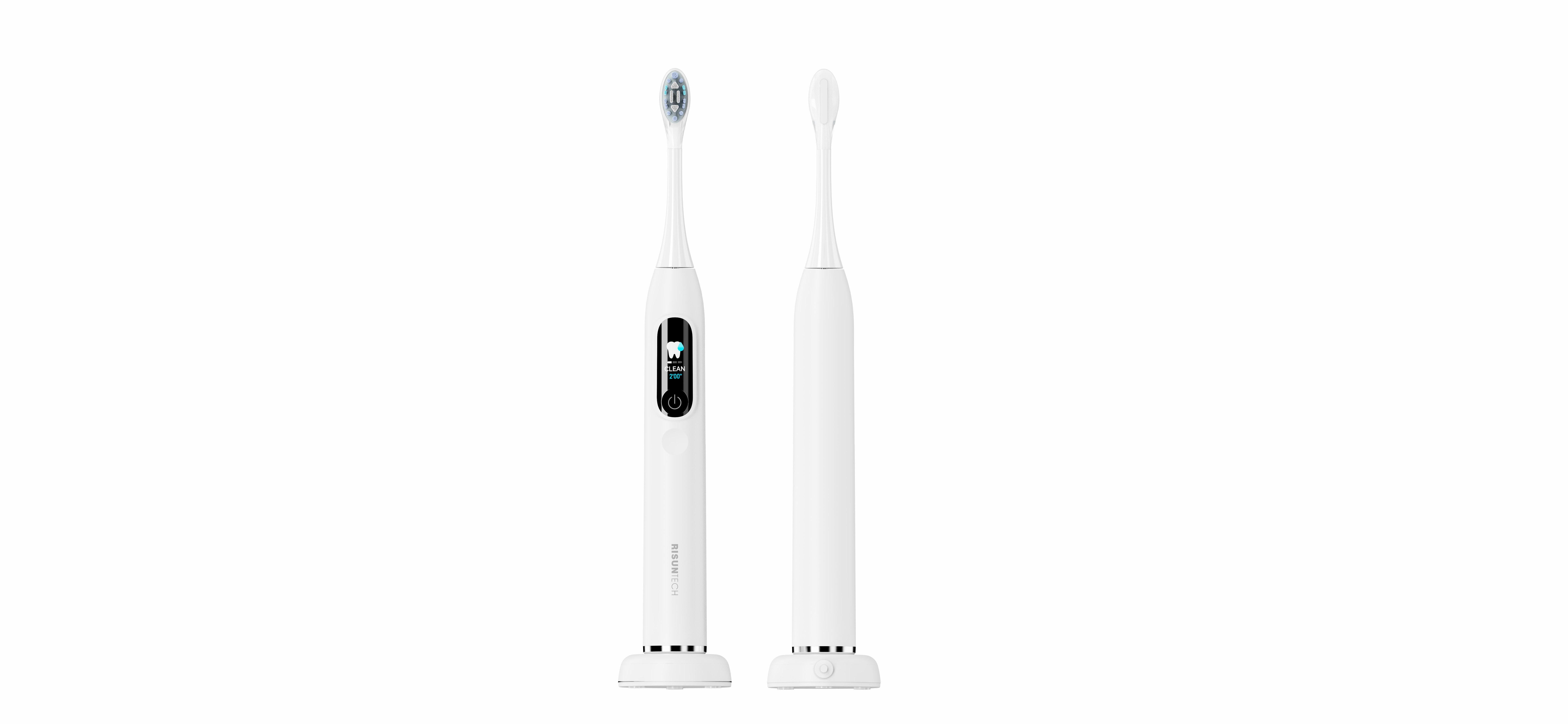
Adding intelligence to a toothbrush multiplies the number of variables that must be locked before production. A basic rechargeable toothbrush needs a motor, a battery, a switch, and a sealed housing. A smart model adds a pressure sensor, a display, brushing-zone tracking, mode and intensity memory, and often a charging base with a specific plug standard.
Three constraint layers then appear at the same time:
- Parameter constraints. Vibration frequency, mode count, battery capacity, charging method, runtime, noise level, and ingress protection must all be defined against a specific model, not against a category.
- Certification constraints. Management-system certificates (ISO 9001, ISO 13485, MDSAP, amfori BSCI) describe how a factory is controlled. Product-level documents (a declaration of conformity, a RoHS declaration, a registration) describe a specific model for a specific market. Buyers who treat these as one category usually discover the gap during customs clearance or retail onboarding.
- Commercial constraints. Minimum order quantity, monthly capacity, tooling, and lead time determine whether a specification is realistic at the volume the brand actually plans to sell.
The practical rule: a smart electric toothbrush quotation is only comparable to another quotation when both are tied to the same model number, the same charging standard, the same protection rating, and the same certificate scope. Anything else is a feature list, not a sourcing decision.
Industry Background: Market and Regulatory Conditions Buyers Should Plan Around
Demand-side context helps a buyer size a smart electric toothbrush programme before contacting suppliers. According to Grand View Research, the global electric toothbrush market was valued at USD 4.3 billion in 2024 and is projected to reach USD 6.8 billion by 2030, a CAGR of 7.8% from 2025 to 2030. The same source reports that Asia Pacific accounted for a revenue share of 34.2% in 2024, which is consistent with the region's concentration of oral-care manufacturing capacity. For buyers evaluating adjacent products, IMARC Group reports that the global water flosser market reached USD 1.06 billion in 2025 and is projected to reach USD 1.64 billion by 2034.
Regulatory constraints matter just as much as demand. The U.S. Food and Drug Administration classifies electric toothbrushes as Class I or Class II medical devices depending on the technology used and the claims made (21 CFR 872.6865). In the European Union, small electronic devices — electric toothbrushes included — have been required to adopt USB-C charging ports under the Radio Equipment Directive amendment that took effect on 28 December 2024.
Those two rules alone explain why a smart electric toothbrush specification cannot be copied from an older product file. A charging interface that was acceptable in an earlier model may now be a market-access blocker in the EU, and a cleaning claim that is harmless in one market can change the device classification in another.
Specification Baseline for Smart Electric Toothbrush OEM Projects
A workable smart electric toothbrush brief defines at least eight parameter groups. The values below come from Risuntech's current smart and sonic platforms, which give buyers a realistic reference range rather than a theoretical one.
Motor and cleaning performance
- Up to 40,000 vibrations per minute on the smart sonic platforms (T2426, T2428, T2432, T2431B0, T2411, T2407, T2422).
- Up to 38,000 vibrations per minute on T2409, which uses the same charging architecture with a different motor configuration.
- Up to 8,800 oscillations per minute on the oscillating platforms T2231, T2232 and T2233.
- Torque output of 300 gf.cm on T2407 and T2422 for buyers who need a defined mechanical load rather than frequency alone.
Modes, intensity and control
- 4 modes (Clean, Soft, Whiten, Massage) on T2411, T2407 and T2432.
- 5 modes (Clean, Soft, Whiten, Massage, Polish) on T2409, T2425, T2428 and T2426.
- 5 modes with 3 intensity levels each on T2426 and T2431B0, giving 15 selectable cleaning plans.
- Mode memory, or mode and intensity memory, retains the user's last setting after the device is switched off.
- Stepless speed adjustment on T2432 allows continuous rather than stepped control.
Feedback and display
- Triple pressure sensor with a visible indicator on T2426 and T2428.
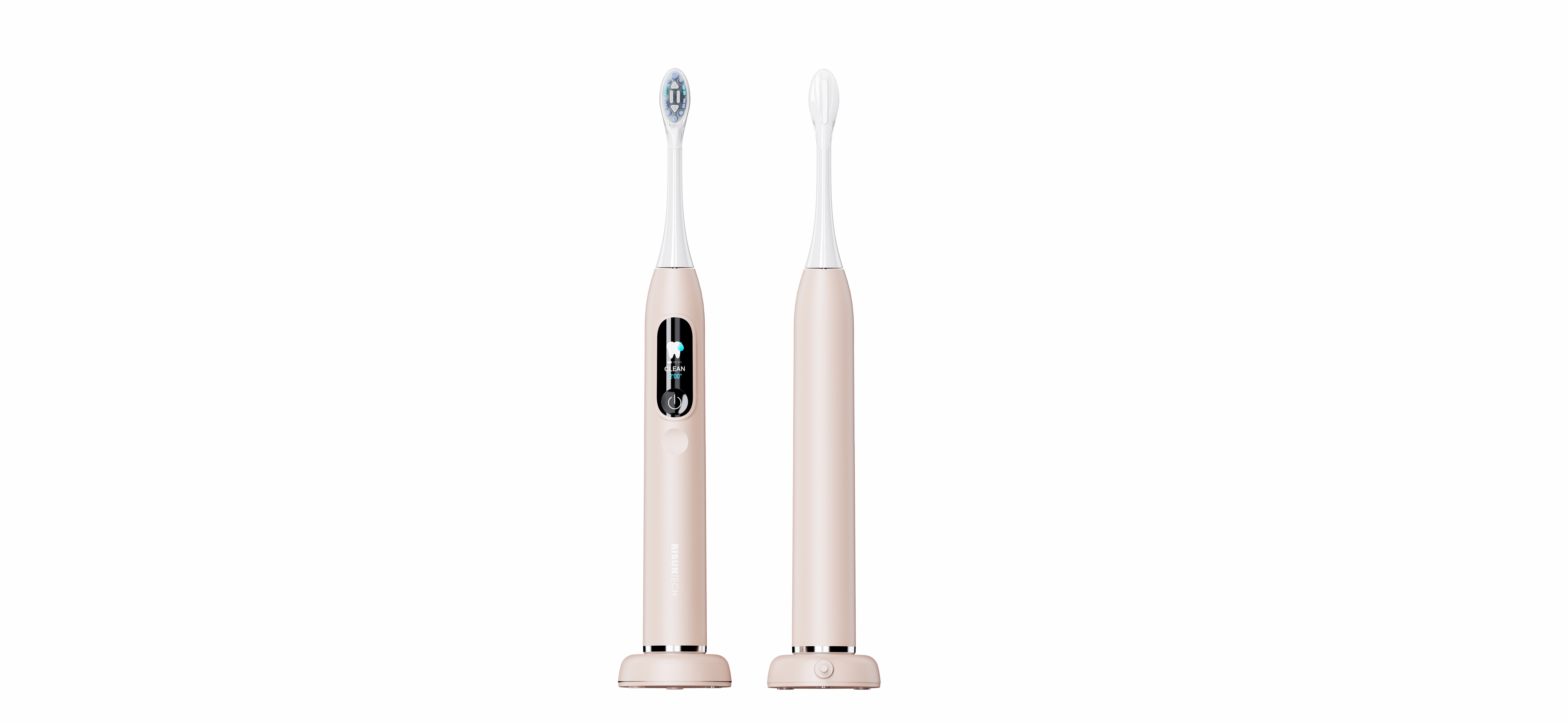
- LED smart colour screen on T2426; LCD colour screen on T2428 and T2409, displaying working mode, battery level, brushing time and brand logo.
- A six-axis gyroscope on T2426 generates a brushing report across six dental zones.
- 3-second gradual start-up reduces toothpaste splashing on models including T2407, T2426, T2428 and T2432.
Battery, charging and runtime
- Battery capacity across the sonic range is 600 mAh (T2431B0), 650 mAh (T2411, T2425, T2428, T2422) or 800 mAh (T2409, T2432, T2407, T2426) lithium-ion.
- Charging methods include USB Type-C cord charging (T2411, T2409), rectangular inductive charging (T2425, T2428, T2426), wireless inductive charging with USB port (T2432, T2431B0) and DC charging (T2407, T2233).
- Charging time ranges from 6 hours on T2411 to 20 hours on T2425 and T2428.
- Runtime ranges from 80 minutes on T2411 to 360 minutes on T2132 in Clean mode, and up to 240 minutes on T2426 in Soft mode.
- The oscillating platform T2231 accepts 100–240 V world-wide voltage, which simplifies distribution across regions with different mains supplies.
Ingress protection, noise and materials
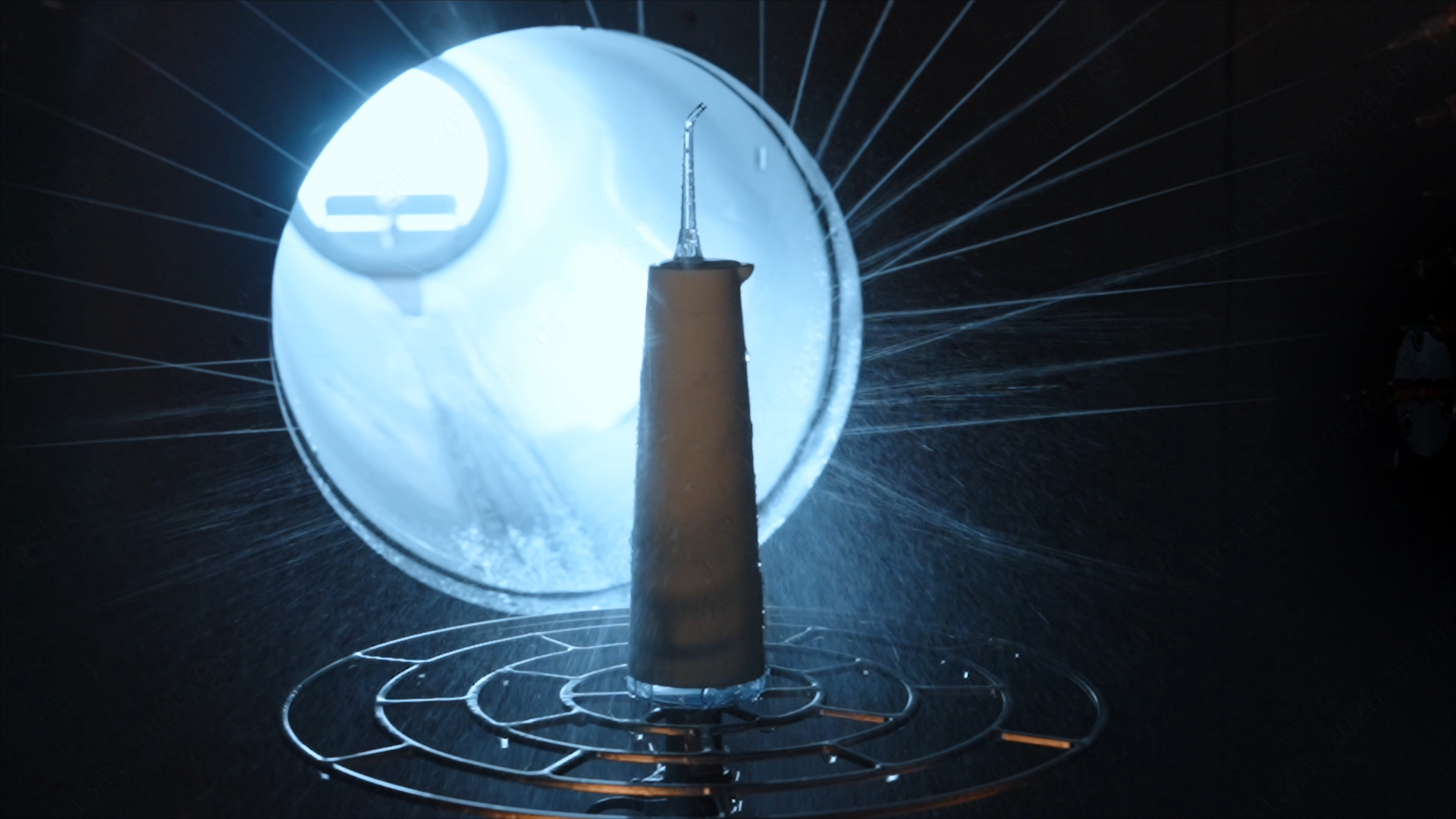
- IPX7 waterproofing is consistent across the smart, sonic and oscillating ranges listed here.
- Startup noise is specified at 55 dB on T2432 and T2132, 55–58 dB on T2428, 62 dB on T2426 and 65 dB on T2411; the oscillating T2232 is rated below 70 dB at 10 cm.
- Housings are plastic; T2407 and T2422 use a brush head wrapped in food-grade TPE.
- Brush heads use DuPont bristles on the oscillating models; T2425 uses Pedex reminder-type bristles that fade in colour to signal brush head replacement, and T2426 uses copper-free brush heads with a rubber coating.
- T2411 uses anchorless planting bristle technology designed to avoid metal rust and to increase bristle quantity by 40%.
Certification and Compliance Documents That Must Be Verified
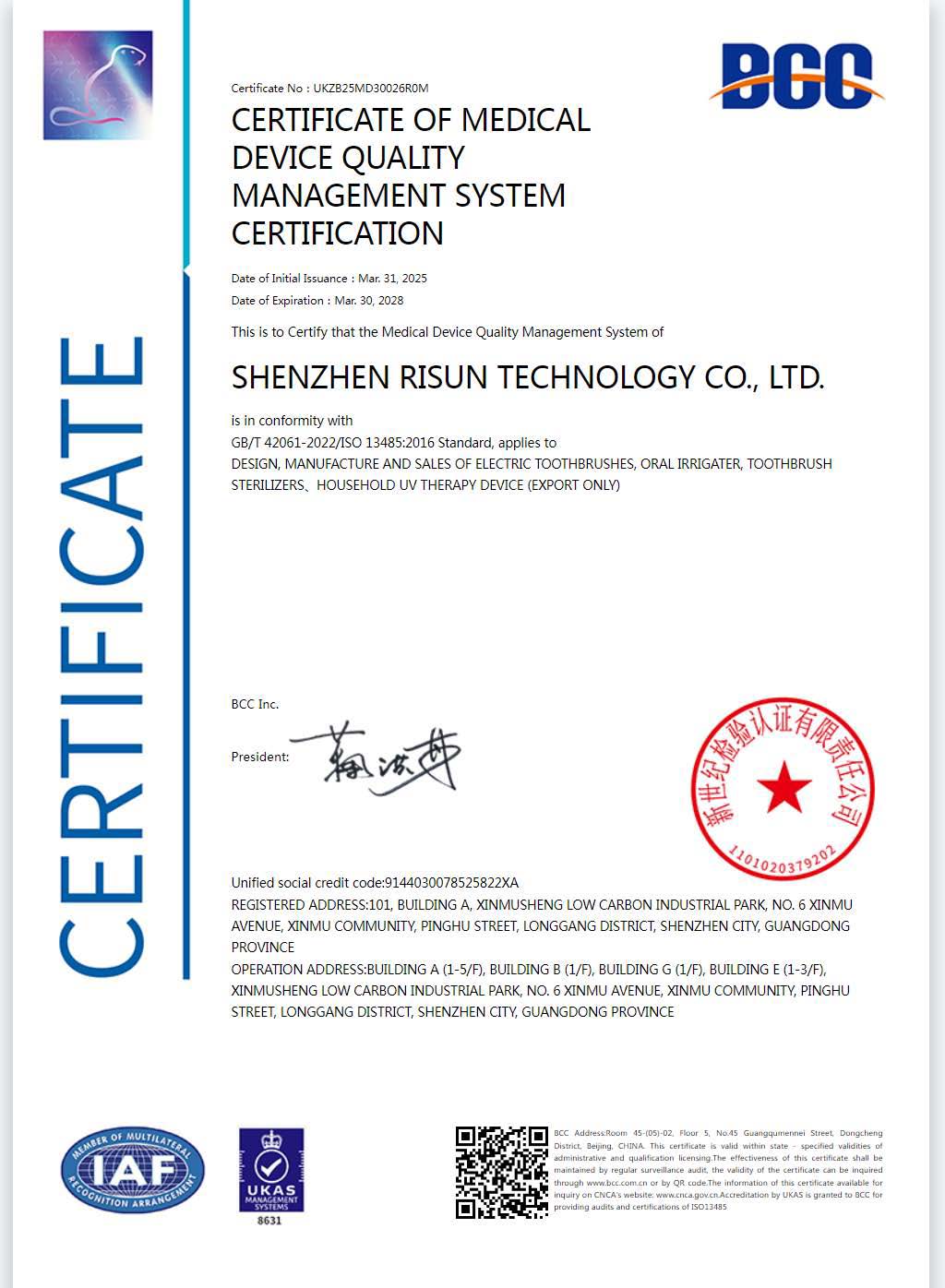
Certification is where most smart electric toothbrush evaluations fail — not because suppliers lack documents, but because buyers compare document titles instead of document scope. Four certificates currently cover Risuntech's oral-care manufacturing operation. Each one should be checked for certificate number, issuing body, standard, validity period, market, and covered product scope.
| Certificate | Number | Issuing body | Standard | Validity | Market / scope |
|---|---|---|---|---|---|
| ISO 9001 quality management system | 016SZ26Q300651R101 | Beijing New Century Certification Co., Ltd. (BCC Inc.) | GB/T19001-2016 / ISO9001:2015 | Issued 2023-10-09; stated expiry 2026-10-08 | Global. Covers design, production and sales of electric toothbrushes, oral irrigators and toothbrush disinfectors. |
| ISO 13485 medical device quality management system | UKZB25MD30026R0M | BCC Inc. | GB/T 42061-2022 / ISO 13485:2016 | Issued 2025-03-31; valid until 2028-03-30 | Export market. Covers design, manufacture and sales of electric toothbrushes, oral irrigators, toothbrush sterilizers and household UV therapy devices. |
| MDSAP | 0119427-02 | Intertek | ISO 13485:2016; Canada SOR 98/282; US 21 CFR 820, 803, 806, 807 | Issued 2024-12-26; valid until 2027-12-26 | Canada and United States. Covers design and manufacture of electronic toothbrushes and oral irrigators, plus contract manufacture of UV sanitizer for toothbrushes. |
| amfori BSCI social audit report (follow-up monitoring) | amfori ID 156-000098-000; Site ID 156-000098-004 | ALGI HOLDING COMPANY LLC | amfori BSCI Code of Conduct | Valid 2026-05-14 to 2027-05-15 | Global, with particular relevance to European retailers. Covers production of electric toothbrush and oral irrigator at RISUN TECHNOLOGY (SHENZHEN) LIMITED. |
Two verification habits reduce risk immediately. First, ask for the certificate file itself, not a logo. Second, map the certificate scope to the model being quoted. The ISO 9001 certificate above names T2411, T2425, T2428, T2409, T2432, T2422, T2233 and T2132 among the covered products; ISO 13485 and MDSAP cover the electronic toothbrush and oral irrigator categories in the design, manufacture and sales scope.
The expiry dates also matter. Because the ISO 9001 certificate shown here carries a stated expiry of 2026-10-08, a buyer starting an evaluation in late 2026 should request the current re-certification file rather than relying on the archived version. That is a normal part of supplier due diligence, not a red flag.
CE, RoHS and the difference between a system certificate and a product declaration
CE marking and RoHS compliance are product-level obligations. They are demonstrated through declarations of conformity, test reports and, where applicable, registration — each tied to a specific model, a specific configuration and a specific market. A management-system certificate such as ISO 9001 or ISO 13485 supports the supplier's ability to control that process, but it does not, by itself, prove that a given smart electric toothbrush model satisfies CE or RoHS requirements.
For a China-based sonic electric toothbrush supplier being evaluated for European distribution, the practical document request is therefore three-layered: the quality management certificates listed above, the product-level conformity documentation for the exact model, and a written statement of which configurations are covered. Buyers should also confirm the classification position for the U.S. market, where electric toothbrushes fall under FDA Class I or Class II depending on technology and claims.
Commercial Constraints: MOQ, Capacity, Lead Time and Customization
Specification and certification only become a programme when the commercial terms support the volume. Risuntech operates an OEM and ODM model with the following working parameters:
- MOQ: 1,000 pcs.
- Monthly capacity: 30,000 units.
- Lead time: 30–45 days.
- Quality control: 100% inspection.
- Export markets: United States and European Union.
- After-sales: one year.
Customization scope is a separate negotiation item, and it is broader than packaging. The confirmed customization fields are appearance, logo, packaging, functions, accessories, certification labels, software UI and user manual. For a smart electric toothbrush project, software UI and certification labels are usually the two that create the longest review cycles, because both sit at the boundary between product engineering and market compliance.
Multi-site manufacturing is also a commercial constraint in practice. Risuntech operates manufacturing bases in Shenzhen and Nanchang in China and in Vietnam, which gives buyers an alternative production location when tariff exposure, regional demand or continuity planning requires it.
Step-by-Step Breakdown: How to Evaluate a Smart Electric Toothbrush Supplier
- Lock the market access requirements first. Confirm the FDA classification position for the U.S. and the USB-C charging requirement for the EU before the specification is written. Retro-fitting a charging interface after tooling is far more expensive than specifying it correctly at the start.
- Freeze the specification baseline. Choose the motor frequency, mode and intensity count, feedback type, display type, battery capacity, charging method, runtime target, noise ceiling and IP rating. Attach a model number to each combination.
- Request the certification files, not the certificate names. Check certificate number, issuing body, standard, validity period, market and product scope against the model being quoted.
- Separate system certificates from product declarations. Treat ISO 9001, ISO 13485, MDSAP and amfori BSCI as evidence of process control, and CE/RoHS documentation as model-level evidence. Ask for both.
- Confirm MOQ, capacity and lead time in writing. A 1,000 pcs MOQ with a 30–45 day lead time and 30,000 units of monthly capacity sets the planning envelope for launch and replenishment.
- Validate with samples and test records. Reliability evidence for the oral-care platforms includes IPX7 waterproofing, drop testing, 72-hour motor durability and 300-cycle battery performance, supported by a 27-step quality control system.
- Agree the customization boundaries. Define which of appearance, logo, packaging, functions, accessories, certification labels, software UI and user manual are in scope, and who owns approval for each.
Use Cases: Where the Smart Electric Toothbrush Specification Fits
Private label and e-commerce launches
A brand entering the smart segment typically needs a differentiated product without a new platform. T2426 and T2428 provide that position: 5 modes, pressure sensing, a colour display and IPX7 protection, with logo, packaging and software UI open to OEM customization. The applicable industries listed for the smart platforms include oral care brands, private label and e-commerce.
Family and travel kits
Daily home oral care and travel environments are the two stated working conditions for the oral-care application profile. Combo kits, travel editions and single-handle-plus-replacement-head packs are the corresponding operation modes. Travel restrictions on liquids and batteries, plus child safety considerations, are the constraints that shape the kit configuration.
Dental, hospital and medical channels
The sonic and oscillating platforms list dental clinic, hospital and medical among their applicable industries. ISO 13485 and MDSAP coverage is what makes this channel commercially viable, because the buyer's quality team will expect a medical device quality management system rather than a general manufacturing certificate.
European retail distribution
The amfori BSCI social audit report is specifically relevant to European retailers, which typically require a social compliance audit as part of vendor onboarding. Combined with the EU USB-C requirement, this makes the European channel a compliance-first decision rather than a price-first one.
Smart Electric Toothbrush Specification Comparison
The table below compares the smart and sonic platforms on the parameters that most often appear in buyer specification sheets. All values are as stated in the product specifications.
| Model | Modes | Vibration / oscillation | Battery | Charging | Runtime | Noise | Waterproof |
|---|---|---|---|---|---|---|---|
| T2426 | 5 modes, 3 intensity levels each | Up to 40,000 vibrations/min | 800 mAh Li-ion | Inductive charging base with USB port; 5 h charge | Up to 240 min (Soft) | 62 dB | IPX7 |
| T2428 | 5 modes | 40,000 vibrations/min | 650 mAh Li-ion | Inductive charging base with US/EU plug; ≤20 h charge | 120 min (Soft) | 55–58 dB | IPX7 |
| T2432 | 4 modes | 40,000 vibrations/min | 800 mAh Li-ion | Wireless inductive charging with USB port; 12 h charge | 180 min (Soft) | 55 dB | IPX7 |
| T2431B0 | 5 modes, 3 intensity levels each | Up to 40,000 vibrations/min | 600 mAh Li-ion | Wireless inductive charging | 120 min (Gentle) | — | IPX7 |
| T2411 | 4 modes | Up to 40,000 vibrations/min | 650 mAh Li-ion | USB Type-C; 6 h charge | 80 min | 65 dB | IPX7 |
| T2409 | 5 modes | Up to 38,000 vibrations/min | 800 mAh Li-ion | USB Type-C cord charging | 180 min | — | IPX7 |
| T2425 | 5 modes | Up to 40,000 vibrations/min | 650 mAh Li-ion | Inductive charging; 20 h | 120 min | — | IPX7 |
| T2407 | 4 modes | Up to 40,000 vibrations/min; 300 gf.cm torque | 800 mAh Li-ion | DC charging | 25 days (Soft, 2 min twice daily) | — | IPX7 |
Read the table as a constraint map rather than a ranking. A brand that needs a visible brushing report should start with T2426; a brand that needs the longest single-charge runtime in the rechargeable range has T2132 at 360 minutes in Clean mode; a brand entering the EU after December 2024 should confirm the USB-C position for any model it shortlists.
Frequently Asked Questions
Which certifications should a China sonic electric toothbrush manufacturer provide for CE and RoHS compliance?
CE marking and RoHS compliance are product-level requirements, so the core documents are a declaration of conformity and supporting test evidence for the exact model, configuration and market. These sit on top of the supplier's management-system certificates. Risuntech holds an ISO 9001 certificate (016SZ26Q300651R101, issued by Beijing New Century Certification Co., Ltd.), an ISO 13485 certificate (UKZB25MD30026R0M, issued by BCC Inc., valid until 2028-03-30), an MDSAP certificate (0119427-02, issued by Intertek, valid until 2027-12-26, covering Canada and the United States) and an amfori BSCI social audit report (amfori ID 156-000098-000, valid to 2027-05-15). Buyers should request both the system certificates and the model-level CE/RoHS files, then confirm that the model number on the declaration matches the model number on the quotation.
What specifications should a smart electric toothbrush OEM project define before requesting a quotation?
At minimum: motor frequency or oscillation rate, mode count and whether intensity levels are included, feedback type (such as a triple pressure sensor), display type (LED smart colour screen or LCD colour screen), battery capacity, charging method, charging time, runtime, startup noise ceiling, ingress protection rating, brush head material, and whether mode or intensity memory is required. Risuntech platforms cover these values explicitly — for example, T2426 is specified at 5 modes with 3 intensity levels each, up to 40,000 vibrations per minute, an 800 mAh Li-ion battery, a 5-hour inductive charge, up to 240 minutes of runtime, 62 dB startup noise and IPX7 waterproofing.
What are the MOQ, monthly capacity and lead time for OEM smart electric toothbrush orders?
The stated working terms are a minimum order quantity of 1,000 pcs, a monthly capacity of 30,000 units, and a lead time of 30–45 days, with 100% quality control and a one-year after-sales period. Customization can cover appearance, logo, packaging, functions, accessories, certification labels, software UI and user manual. Buyers planning a launch should map these figures against their first-year volume, because a 1,000 pcs MOQ and a 30–45 day lead time determine the earliest realistic shelf date.
How should a buyer validate a smart electric toothbrush sample before mass production?
Sample validation should test the constraints that are hardest to change later. Reliability evidence for the oral-care platforms includes IPX7 waterproofing verification, drop testing, 72-hour motor durability and 300-cycle battery performance, supported by a 27-step quality control system. Buyers should request the test records that correspond to the specification they ordered, confirm the charging method against the target market requirement, and check that the display, pressure feedback and mode memory behave as specified on the production-intent sample rather than on a hand-built prototype.
How can a brand start a smart electric toothbrush sample or quotation request with Risuntech?
Start with a short brief that names the target market, the intended retail channel, the required specification baseline and the expected first-order volume. Because Risuntech operates as an OEM and ODM manufacturer with multi-site production in Shenzhen, Nanchang and Vietnam, the response can address specification feasibility, certification coverage and lead time in one step. The 2026 product brochure is available for download at RISUNTECH E-SHEET 2026, and sample or quotation requests can be sent to Marketing@risuntech.cn. For faster routing, use WhatsApp at +86 13322605965.
Conclusion
A smart electric toothbrush project is decided by constraints, not by features. The specification baseline — motor frequency, modes and intensity, feedback, display, battery, charging, runtime, noise and IP rating — determines what can be built. The certification stack — ISO 9001, ISO 13485, MDSAP and amfori BSCI, each with its own number, scope and validity period — determines where it can be sold. The commercial envelope — 1,000 pcs MOQ, 30,000 units of monthly capacity and a 30–45 day lead time — determines when it can reach the shelf.
Buyers who verify those three layers against a named model, rather than against a category description, move from research to evaluation with far fewer surprises. The documents and specifications referenced in this guide are the same ones a procurement team will be asked to defend internally, which is precisely why they should be requested in verifiable form at the first supplier contact.
Request a smart electric toothbrush sample or quotation
Share your target market, required specification baseline and expected order volume, and Risuntech will respond with model recommendations, certification coverage and lead time. Download the product brochure, or contact the team directly.
Download the RISUNTECH E-SHEET 2026 brochure | Email: Marketing@risuntech.cn | WhatsApp: +86 13322605965 | Tel: +86 755 8969 9169 – 8255
Have Questions or Need More Details?
Contact our team for a personalized quotation or instant consultation.
Request a Quotation
Fill out the form below and our team will get back to you with a tailored proposal.
WhatsApp Direct Chat
Prefer to chat in real-time? Message us on WhatsApp for instant assistance & quick answers.
- Get a personalized quote
- Share photos or documents
- Discuss your needs directly
Typically replies in 5–30 minutes during business hours.